
- Questo evento è passato.
Learning the physics of free-surface fluid flows with AI
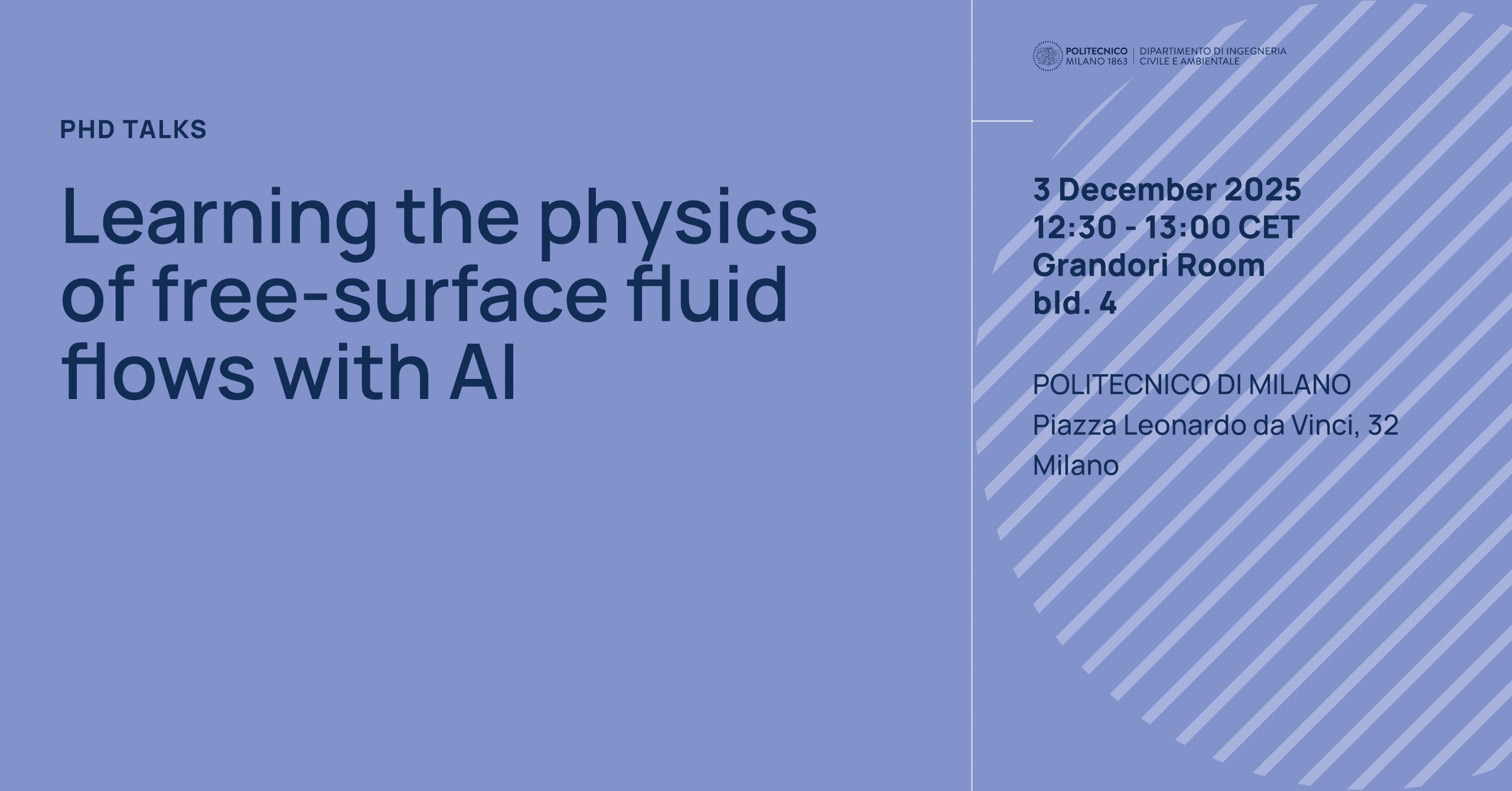
Il prossimo appuntamento con la serie di incontri PhDTalks si terrà Mercoledì 3 dicembre nell’aula Grandori (Edificio 4), dalle 12:00 alle 13:00 CET.
PhDTalks è una serie di seminari e discussioni tra dottorandi. Gli eventi hanno lo scopo di fornire un luogo dove creare un network tra dottorandi ed entrare in contatto con i molti progetti sviluppati nel nostro dipartimento.
Lo speaker Federico Lanteri condurrà un seminario dal titolo “Learning the physics of free-surface fluid flows with AI”.
Al termine dell’evento sarà disponibile un piccolo rinfresco finanziato dal dipartimento.
Sarà possibile seguire la conferenza anche online al seguente link.
Abstract
The study of free-surface fluid flows is of significant interest across various research fields, including civil, aerospace, and biomedical engineering. Numerical simulations approximating Navier–Stokes equations provide accurate descriptions of such phenomena but are often computationally expensive for real-world applications. In recent years, deep learning has emerged as a promising approach for modeling complex physical systems, offering data-driven alternatives to traditional solvers. However, applying these techniques to free-surface flows is particularly challenging compared to standard fluid dynamics problems on fixed geometries, as it requires neural network architectures capable of handling unstructured and dynamically evolving domains. By carefully designing such architectures and training them on datasets generated from high-fidelity numerical simulations, it is possible to learn the complex underlying physics governing free-surface dynamics, effectively building surrogate models that reproduce accurate solutions at a fraction of the computational cost. This approach opens new perspectives for real-time analysis, optimization, and control in engineering applications involving free-surface flows.
Speaker’s bio
Federico is a PhD candidate in Structural, Seismic, and Geotechnical Engineering (40th cycle). He obtained a master degree in Mathematical Engineering in 2024 and he is now in the second year of his PhD. His work focuses on developing machine-learning methods to enhance and speed up simulations of free-surface fluid flows, in particular cases involving complex materials.