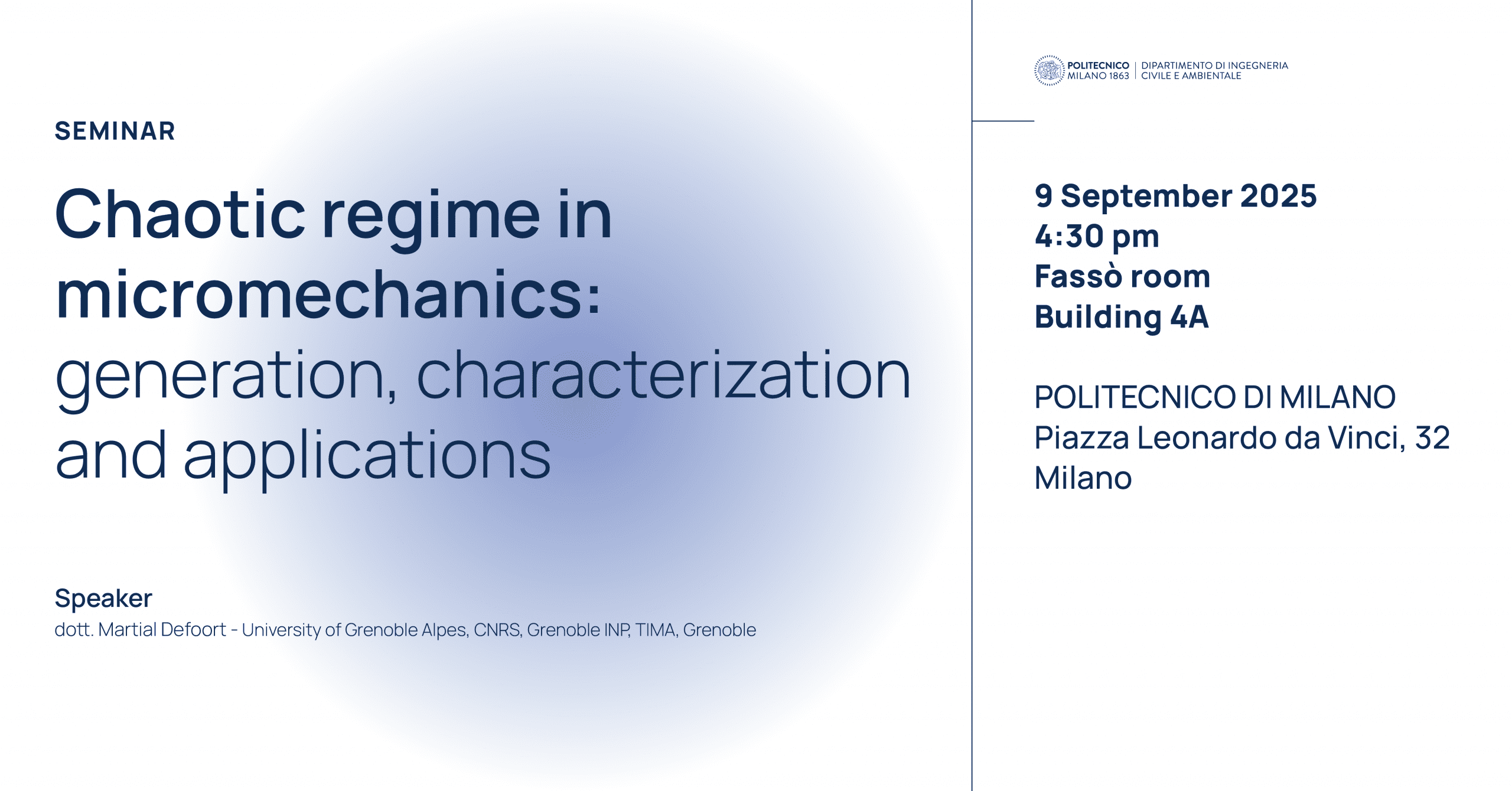
Martedì 9 settembre si terrà un seminario presso l’aula Fassò (Edificio 4A) dalle ore 16:30 dal titolo “Chaotic regime in micromechanics: generation, characterization and applications”.
Il seminario sarà tenuto dal Dr. Martial Defoort, University of Grenoble Alpes, CNRS, Grenoble INP, TIMA, Grenoble.
Sarà anche possibile seguire il seminario da remoto tramite il seguente link: https://politecnicomilano.webex.com/meet/valentina.zega
Abstract
Micromechanical systems have become essential in the development of the latest technologies, from cars to smartphones to medical implants. Due to their size, these devices offer fast response times, low power consumption, and high sensitivity, creating a buzz in both academic and industrial research. This ambivalence creates a direct bridge between fundamental research and engineering science, exploiting complex behaviors for specific applications. This is the case for nonlinear phenomena, often considered undesirable, but which also offer new perspectives and give rise to disruptive applications.
This presentation will focus on one nonlinear phenomenon in particular: the chaotic regime in mechanical microresonators. After a general introduction to chaos and its generation in microtechnologies, a second part will be dedicated to the experimental characterization of this regime within a microelectromechanical system (MEMS) in order to assess the richness of the chaos thus generated. The final part of this presentation will discuss the various possible applications, from improving transducer performance to secure communications.
—
Speaker’s bio
Martial Defoort completed his doctoral studies in fundamental research at Intitut Néel, Grenoble, in 2014 on nonlinear micro/nanomechanics. He then pursued postdoctoral research at the University of California, Davis, focusing on applied research and in particular synchronization of MEMS gyroscopes. Coming back to France, he obtained a postdoctoral position at CEA-Léti, where he explored NEMS-arrays for mass spectrometry applications. In 2020, he joined the laboratory Techniques de l’Informatique et de la Microélectronique pour l’Architecture de systèmes intégrés (TIMA) in Grenoble as a CNRS research scientist, specializing in nonlinear physics, MEMS and chaos-based applications. In particular, he focuses his research on how to leverage chaos properties in MEMS for sensing and security applications.