
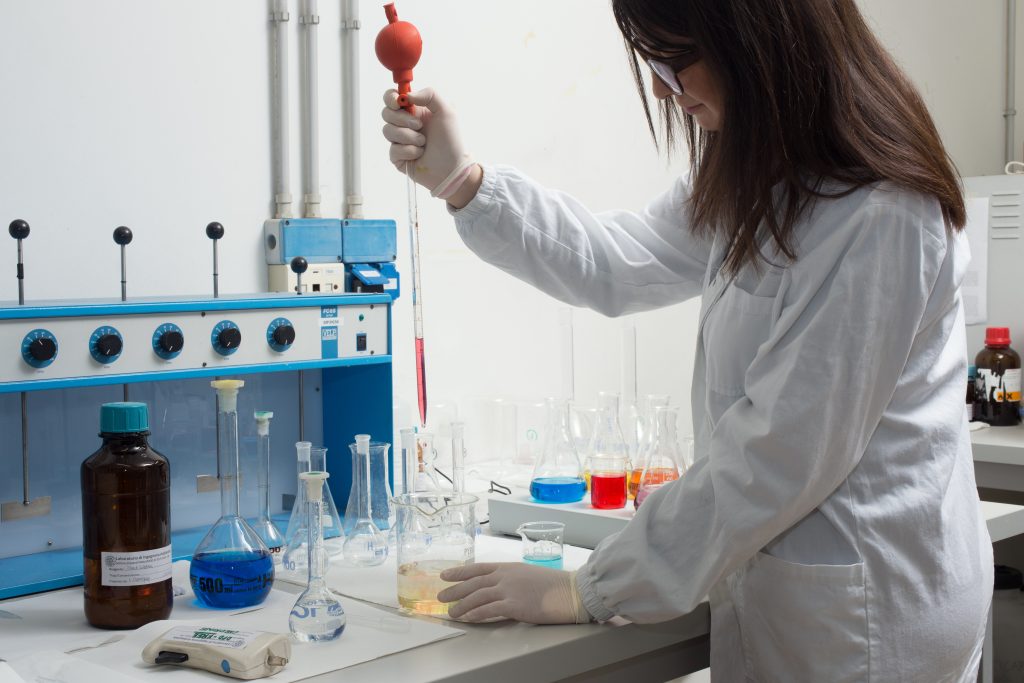
The Environmental section is composed of two main research laboratories: the Environmental Engineering Laboratory (LIA) and FabE-lab. Both focus on key issues for environmental sustainability and the recovery of natural resources, offering innovative and sustainable solutions to address global environmental challenges.
Environmental Engineering Laboratory (LIA)
LIA, based at the Leonardo Campus, focuses on applied research and technological development for the protection of environmental quality and the remediation of water, soil, and air. Activities concentrate on advanced measurement and monitoring of thepollution: chemical, physical, and, to some extent, microbiological, as well as the research and validation of sustainable solutions and technologies for remediation and the recovery of resources and energy, within the framework of funded projects, in-house research, and external requests. The main lines of activity include:
- Environmental monitoring: sampling and analysis of liquid, solid, and gaseous matrices (natural, drinking, and wastewater, air and gas emissions, soils and sediments, waste) using classical techniques (gravimetry, volumetry, colorimetry) and advanced instrumental methods (including GC-MS/MS, ICP-MS, ion chromatography).
- Characterization and treatability: experimental studies on contaminants and the treatability of wastewater, water, and contaminated soils, with specific tests to evaluate the effectiveness of treatment technologies and the determination of key parameters for plant design.
- Environmental remediation technologies: evaluation, development, and optimization, at laboratory and pilot scale, of solutions for the recovery and purification of environmental matrices through processes biological, chemical-physical and physical, with focus on sustainability and efficiency.
- Drinking water treatment and advanced purification: design and testing of advanced treatments for the removal of micropollutants (e.g., microplastics, pharmaceuticals, pesticides, PFAS) and the production of drinking water from complex sources.
- Resource recovery: development of processes for the reuse of treated water and the recovery of resources, energy, or raw materials from waste or contaminated environmental matrices.
FabE-lab
FabE-lab is located on the campus of the Polo di Cremona focuses on and develops two key areas related to the circular economy: anaerobic biochemical processes and the microalgae cultivation. The main lines of research and service activities focus on the valorization of agro-industrial waste. Among the most established activities are:
- the chemical-physical characterization and assessment of the anaerobic biodegradability of organic residues and by-products.
- laboratory-scale tests to evaluate the treatability of waste and residues through innovative processes based on anaerobic processes or photosynthetic microorganisms.
- pilot-scale tests aimed at process validation and optimization
- development of mathematical models of biotechnological processes to support process optimization and control (in collaboration with DEIB).
- of innovative processes such as Anammox for nitrogen removal in anaerobic environments.