Il seminario, intitolato “From agri-food waste to energy and materials: challenges and opportunities of thermal conversion“ si terrà martedì 24 marzo alle ore 10:00, presso l’aula Grandori, e sarà tenuto da Izabella Maj, Assistant Professor presso la Silesian University of Technology di Gliwice (Polonia).
Speaker’s bio
Izabella Maj, PhD, is an Assistant Professor at the Silesian University of Technology in Gliwice, Poland, within the Faculty of Energy and Environmental Engineering. Her research focuses on the thermal conversion of biomass and waste, high-temperature corrosion, ash characterization and utilization, and emission control in energy systems. A key theme of her current work is the sustainable and safe utilization of animal-origin waste—such as poultry litter and cattle manure—within waste-to-energy and circular economy frameworks. She is currently the Principal Investigator of a project funded by the National Science Centre (Poland), investigating the influence of aluminosilicate additives on ash properties and high-temperature corrosion during biomass combustion.
Abstract
The thermal conversion of agri-food waste, particularly animal-origin waste, represents a promising pathway for sustainable waste management and energy recovery within the circular economy framework. Materials such as poultry litter and cattle manure are produced in large quantities worldwide and pose significant environmental challenges when managed through conventional land application, including greenhouse gas emissions, nutrient runoff, and the spread of pathogens and antibiotic residues. Thermal treatment offers an effective alternative, enabling energy recovery while reducing environmental and sanitary risks.
The presentation addresses the combustion and gasification of animal-origin waste, with particular attention to ash behavior, high-temperature corrosion, and valorization pathways for process by-products. Special focus is given to chlorine-induced corrosion mechanisms in power boilers, which represent one of the main operational barriers in waste-to-energy systems. Experimental corrosion studies conducted on boiler steels under controlled temperatures are presented, supported by detailed microstructural and kinetic analyses.
The role of aluminosilicate additives—such as halloysite, kaolin, and bentonite—in modifying ash chemistry is also discussed. Results show that targeted ash modification can significantly influence ash melting behavior, suppress low-temperature melt formation, and reduce corrosion rates by improving oxide scale integrity. Beyond corrosion mitigation, potential utilization routes for biomass ashes are explored, including applications in additive manufacturing (3D printing).
Il prossimo appuntamento con la serie di incontri PhDTalks si terrà Martedì 21 gennaio nell’aula Fassò (Edificio 4A), dalle 17:15 alle 18:30 CET.
PhDTalks è una serie di seminari e discussioni tra dottorandi. Gli eventi hanno lo scopo di fornire un luogo dove creare un network tra dottorandi ed entrare in contatto con i molti progetti sviluppati nel nostro dipartimento.
Lo speaker Samuele Abagnato condurrà un seminario dal titolo “Material Flow Analysis and Life Cycle Assessment in Policy Making for Waste Management: the Case Study of Textile Waste in Lombardy”.
Al termine dell’evento sarà disponibile un piccolo rinfresco finanziato dal dipartimento.
Sarà possibile seguire la conferenza anche online al seguente link.
Abstract
Proper planning of waste management systems for textiles is crucial to reduce the environmental impacts of textile sector. To support policy-making in Lombardy region, first, a Material Flow Analysis (MFA) of the region’s textile waste streams was conducted, and municipal textile waste generation data of the Lombardy’s municipalities were analysed. Then, Life Cycle Assessment (LCA) methodology is applied to the textile waste management system of Lombardy region to quantify its environmental impacts and assess whether increased circularity leads to reduced impacts. The feasibility of applying LCA to textile waste management was explored in scientific literature, and the current state of recycling technologies is discussed. LCA was applied to the management of post-consumer textile waste in Lombardy, and some preliminary results are shown.
Speaker’s bio
Samuele obtained the master’s degree in environmental engineering at the University of Bologna in 2021, with a thesis about the application of life cycle assessment to carbon capture from flue gas. Then he spent one year as research fellow focusing on flue gas treatments for waste to energy plants. In 2022 he started his phd journey at Politecnico di Milano (38th cycle). His research project, in collaboration with Regione Lombardia, is focused on textile waste management in the context of Lombardy region, with the aim to develop analyses to support policy making and public policies at the regional scale about waste management.
In his free time, he loves playing (and watching) basketball, he is interested in culture and politics, and in a lot of other things that we do not have the time to list here.
Il prossimo appuntamento con la serie di incontri PhDTalks si terrà Martedì 18 Aprile nell’aula 2.1.3 (Edificio 2), dalle 17:15 alle 18:30 CET.
PhDTalks è una serie di seminari e discussioni tra dottorandi. Gli eventi hanno lo scopo di fornire un luogo dove creare un network tra dottorandi ed entrare in contatto con i molti progetti sviluppati nel nostro dipartimento.
Lo speaker Giuseppe Cecere condurrà un seminario dal titolo “The role of Social Hotspot analysis in waste management: assessing sectoral social impacts for a better understanding of social risks”.
Al termine dell’evento sarà disponibile un piccolo rinfresco finanziato dal dipartimento.
Sarà possibile seguire la conferenza anche online al seguente link.
Abstract:
Social Life Cycle Assessment (S-LCA) is a methodology developed to assess the negative and positive social impacts of products and services, along their life cycle. The new Guidelines for Social Life Cycle Assessment of Products together with the Methodological Sheets, published in 2021 by the United Nations Environment Programme, provide a roadmap to help stakeholders in the assessment of social impacts of products’ life cycles. However, applications are hindered by the high sensitivity of the data under investigation and the relative novelty of the methodology. The Social Hotspot analysis allows, as a preventive measure and through secondary data, to identify the social issues that should be focused on during risk assessment. This type of analysis that allows the identification of the most sensitive themes can be used as a first step in the application of the S-LCA. In the waste sector, the application of methodologies to assess social impacts could be particularly useful. Waste management facilities often suffer from strong protests both during construction and operation. Phenomena such as Not In My Backyard (NIMBY) syndrome and Locally Unwanted Land Use (LULU) are very common during the planning and implementation of this type of facilities. Most of these objections are often due to a bad communication approach on both sides and a denial of potential social and environmental impacts by plant operators. Using the Product Social Impact Life Cycle Assessment (PSILCA) database, this study aims to identify the social hotspots that characterise the waste and wastewater management industry sector in the Italian context. In order to create a suitable reference scale, the results for Italy were compared with the results of several European countries. The result is an industrial sector risk assessment, calibrated on the European context, which can be used as a first step in the evaluation of subcategories and indicators to be prioritised in the assessment of social impacts in the context of waste and wastewater management facilities.
Speaker’s bio:
Giuseppe is a PhD Candidate in Environmental and Infrastracture Engineering (37° cycle) at Politecnico di Milano. Since 2020, he has been working with the AWARE research group. For his PhD project, he is working on the application of Life Cycle Thinking methodologies to the waste management sector. He holds a Master’s degree from the University of Padua and a Bachelor’s degree from the University of Naples ‘Federico II’.
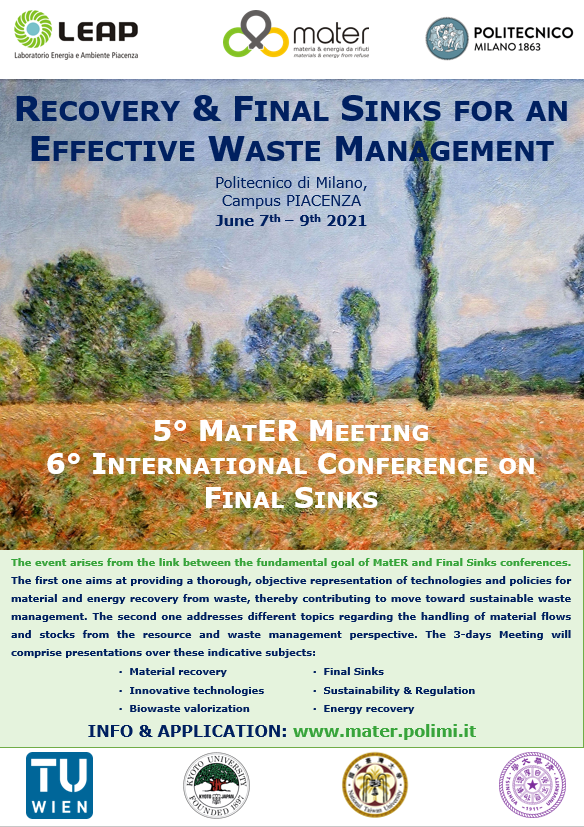
Dal 7 al 9 giugno 2021 presso il campus di Piacenza del Politecnico di Milano, si terrà la quinta edizione del Convegno MatER dal titolo “Recovery & Final Sinks for an Effective Waste Management”, che si terrà in concomitanza con il 6° Convegno Internazionale sui Final Sinks.
L’evento è organizzato con il supporto scientifico del Dipartimento di Ingegneria Civile e Ambientale e del Dipartimento di Energia del Politecnico di Milano e con la collaborazione del LEAP -Laboratorio Energia e Ambiente Piacenza. Per l’edizione 2021 la call for abstracts è indirizzata a contributi di natura sia scientifica che tecnica e verte su 6 topic principali: Material Recovery, Final Sinks, Innovative Technologies, Sustainability &Regulation, Biowaste Valorization ed Energy recovery.
Guarda il flyer dell’evento qui.