
Martedì 9 settembre si terrà un seminario presso l’aula Fassò (Edificio 4A) dalle ore 16:30 dal titolo “Chaotic regime in micromechanics: generation, characterization and applications”.
Il seminario sarà tenuto dal Dr. Martial Defoort, University of Grenoble Alpes, CNRS, Grenoble INP, TIMA, Grenoble.
Sarà anche possibile seguire il seminario da remoto tramite il seguente link: https://politecnicomilano.webex.com/meet/valentina.zega
This presentation will focus on one nonlinear phenomenon in particular: the chaotic regime in mechanical microresonators. After a general introduction to chaos and its generation in microtechnologies, a second part will be dedicated to the experimental characterization of this regime within a microelectromechanical system (MEMS) in order to assess the richness of the chaos thus generated. The final part of this presentation will discuss the various possible applications, from improving transducer performance to secure communications.
Il prossimo appuntamento con la serie di incontri PhDTalks si terrà Martedì 12 novembre nell’aula Fassò (Edificio 4A), dalle 17:15 alle 18:30 CET.
PhDTalks è una serie di seminari e discussioni tra dottorandi. Gli eventi hanno lo scopo di fornire un luogo dove creare un network tra dottorandi ed entrare in contatto con i molti progetti sviluppati nel nostro dipartimento.
Lo speaker Yassine Banani condurrà un seminario dal titolo “Innovative Inertial MEMS: Micro-Systems for Motion Detection for New Fabrication Process”.
Al termine dell’evento sarà disponibile un piccolo rinfresco finanziato dal dipartimento.
Sarà possibile seguire la conferenza anche online al seguente link.
Abstract
Navigation in environments without external references -such as open oceans or airspace above clouds- requires devices that can measure motion without the need to communicate directly with the outside world. This problem has found a solution in devices based on MEMS (Micro-Electro-Mechanical Systems) technology. In particular, MEMS inertial sensors are now the most widely used option for accurately and reliably measuring accelerations and changes in orientation of an object in space. Due to their ability to detect motion and changes in orientation without the need for GPS signal or other external systems. MEMS devices are increasingly being applied in various fields, from air and sea navigation to autonomous vehicles. In this presentation we propose innovative devices that take advantage of a new fabrication process to achieve high performance and reliability in measurements.
Speaker’s bio
Yassine holds an MSc in Civil Engineering from Politecnico di Milano, in 2020. He is currently a PhD candidate in Structural, Seismic and Geotechnical Engineering (38th cycle). His research focuses on the design and numerical simulation of innovative MEMS(Micro-Electro-Mechanical Systems) sensors and actuators for a new fabrication process.
In his free time, he enjoys reading, traveling with friends and eating pasta.
La Professoressa Valentina Zega è stata insignita dell’IEEE Sensors Council Technical Achievement Award – Early Career per i suoi contributi ai sensori inerziali MEMS.
Il Premio per l’Innovazione Tecnica del IEEE Sensors Council viene assegnato a chi ha offerto contributi tecnici di eccezionale rilevanza nell’ambito del IEEE Sensors Council, documentati da pubblicazioni e brevetti. Il riconoscimento si basa sulla qualità complessiva e sull’originalità dei contributi.
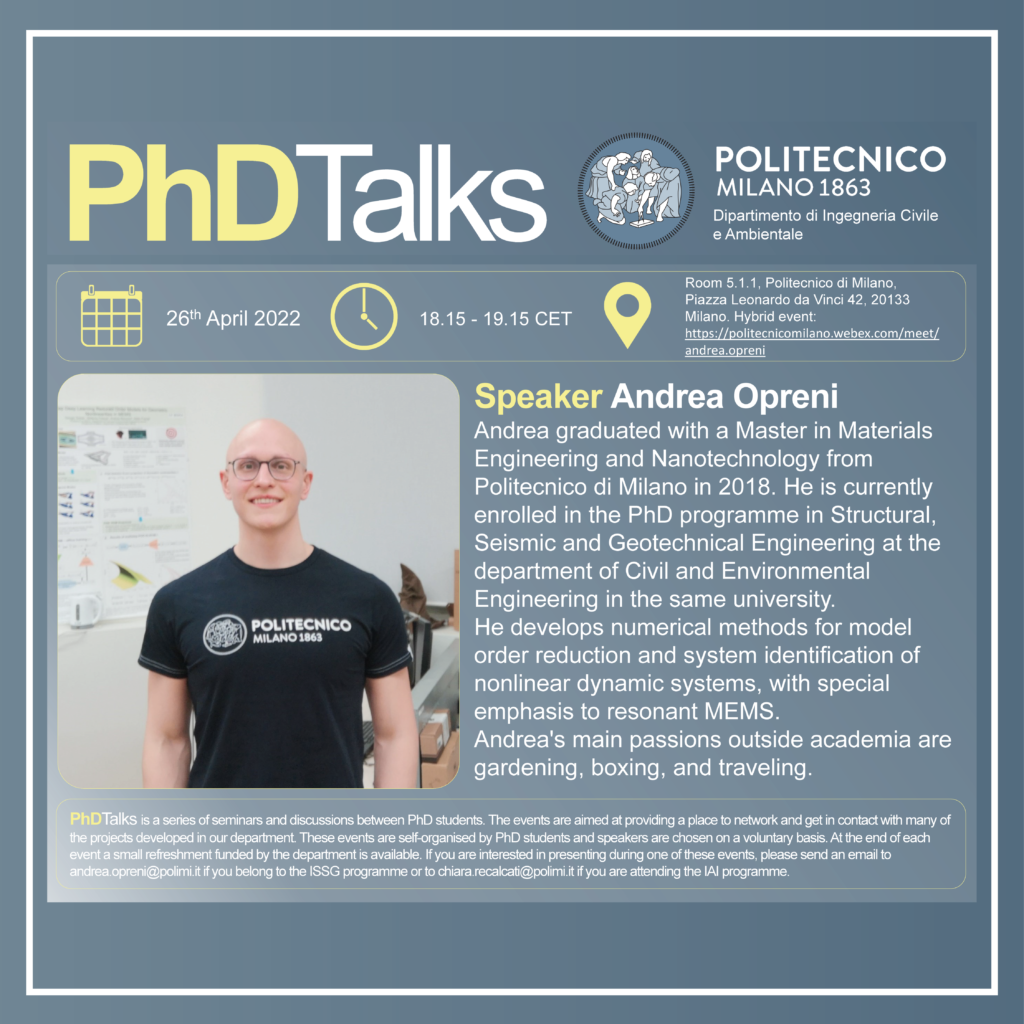
Il nostro prossimo appuntamento con il Seminario PhDTalks si svolgerà martedì 26 aprile 2022 nell’aula 5.1.1 dalle 18:15 alle 19:15 CET.
PhDTalk è una serie di seminari e discussioni tra dottorandi. Gli eventi hanno lo scopo di fornire un luogo dove creare un network tra dottorandi ed entrare in contatto con i molti progetti sviluppati nel nostro dipartimento.
Lo speaker Andrea Opreni ci parlerà di “Designing MEMS in Seconds using Invariant Manifolds”.
Abstract:
Numerical simulations of MEMS are expensive and often not adequate to predict their dynamic response since the computational requirements are too demanding. As a consequence, model order reduction methods are necessary to correctly design such systems. In this talk we will discuss major problems associated to model order reduction of nonlinear vibrating systems with focus on a novel technique called the direct parametrization method for invariant manifolds.
L’evento sarà in presenza presso l’aula 5.1.1, Politecnico di Milano, Piazza Leonardo da Vinci, 42, 20133 Milano.
Al termine dell’evento sarà disponibile un piccolo rinfresco finanziato dal dipartimento.
Se sei interessato a presentare durante uno di questi eventi, invia una e-mail a andrea.opreni@polimi.it se fai parte del programma ISSG oppure a chiara.recalcati@polimi.it se stai frequentando il programma IAI.
