
On Wednesday, October 28, a seminar will be held in Fassò Room (Campus Leonardo, Building 4A, floor 1), starting at 10:15 CET.
The seminar will be given by Prof. Yashar Eftekhar Azam, University of New Hampshire, and is titled “Machine Learning for Bridge Damage Identification under Uncertainty: Contact and Drive-By Sensing”.
Abstract
Developing scalable and practically implementable tools for bridge structural health monitoring requires reliable damage identification under uncertain loading, imperfect modeling, and noisy measurements. This seminar presents a research program that combines machine learning with full-scale experimental validation to advance bridge condition assessment through contact and drive-by sensing.
The presentation covers four complementary components: novelty detection for identifying departures from healthy structural behavior, damage classification for distinguishing among structural condition states, drive-by sensing for assessing bridges through vehicle-mounted measurements, and transfer learning for connecting numerical simulations with field observations. Particular attention is given to traffic load variability, the influence of model uncertainty on damage indices, and the effects of measurement noise on identification performance. Full-scale experiments provide a basis for evaluating these methods under realistic conditions, while transfer learning addresses the limited availability of labeled damage data and discrepancies between simulated and measured responses. Throughout, the emphasis is on translating methodological advances into reliable, implementable tools that can support bridge monitoring at scale.
Speaker’s bio
Yashar Eftekhar Azam is an Associate Professor of Civil and Environmental Engineering and Ocean Engineering at the University of New Hampshire (UNH). He received his Ph.D. with distinction from Politecnico di Milano in 2012 and subsequently held research appointments at ETH Zurich, the University of Thessaly, and the University of Nebraska–Lincoln before joining UNH in 2020. His research integrates structural dynamics, Bayesian estimation, and machine learning to develop practical tools for structural health monitoring and digital twinning of civil and offshore infrastructure. His work combines methodological development with full-scale field experiments and laboratory testing, with particular emphasis on identifying structural states, loads, and damage under uncertainty. Applications include bridge monitoring through contact and drive-by sensing, floating structures, and offshore renewable energy systems. His recent research also explores quantum and hybrid quantum–classical methods for engineering inference. He received the U.S. National Science Foundation CAREER Award in 2025 and UNH’s J. Brent Loy Innovator of the Year Award in 2026.
The seminar can also be followed remotely at the following link: https://politecnicomilano.webex.com/meet/stefano.mariani
Il prossimo appuntamento con la serie di incontri PhDTalks si terrà Giovedì 10 Novembre nell’aula 3.1.6, dalle 18:15 alle 19:15 CET.
PhDTalks è una serie di seminari e discussioni tra dottorandi. Gli eventi hanno lo scopo di fornire un luogo dove creare un network tra dottorandi ed entrare in contatto con i molti progetti sviluppati nel nostro dipartimento.
Lo speaker Seyedpooyan Kazemisangedehi condurrà un seminario dal titolo “Linking Architectural Form and Structural Efficiency of Tall Buildings using Machine Learning”.
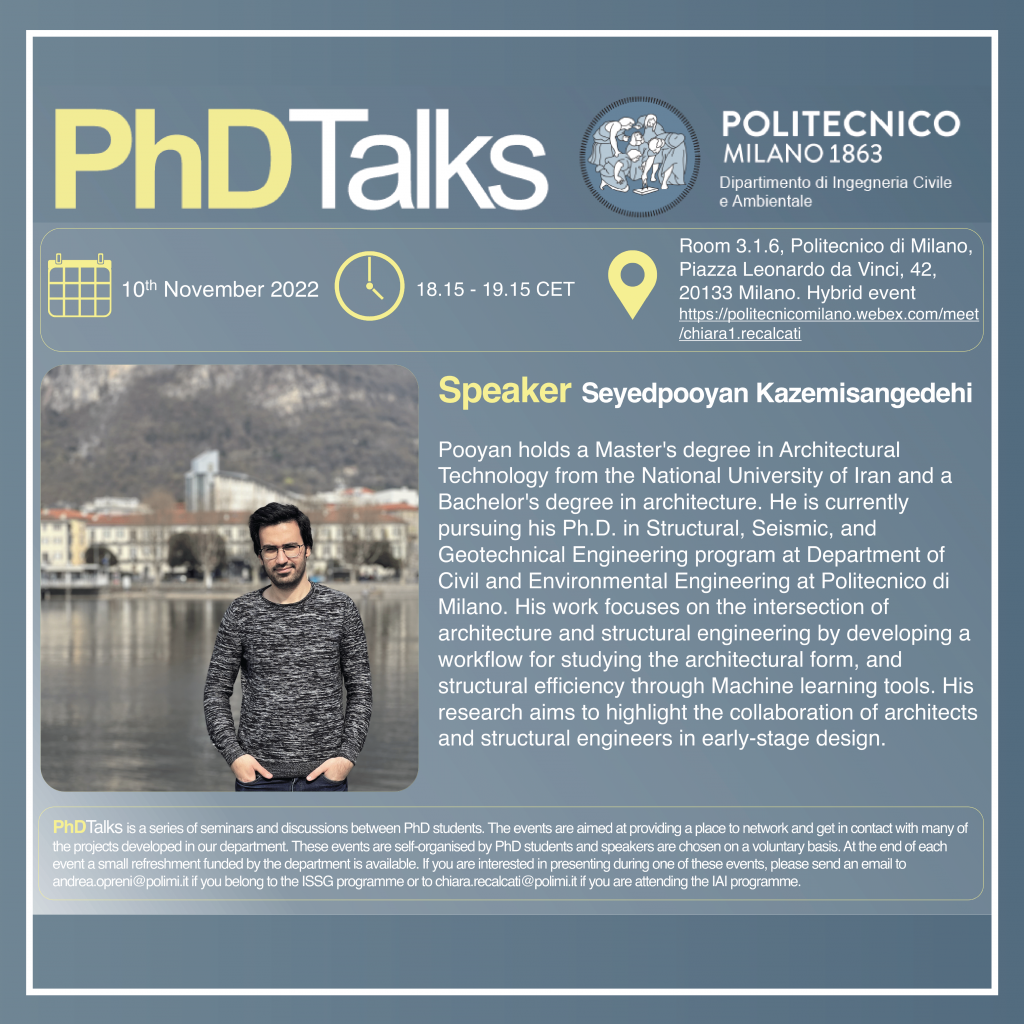
Abstract:
The synergy between architectural form and structural response in the early stages of architectural design reduces the construction costs, and environmental impacts significantly. In this regard, a parametric workflow is proposed to explore the relationship between the architectural form of tall buildings and their structural response to a seismic load using supervised machine learning approaches. This talk presents further details of the suggested workflow using different ML algorithms.
Sarà possibile seguire la conferenza anche online al seguente link.
Al termine dell’evento sarà disponibile un piccolo rinfresco finanziato dal dipartimento.
Se sei interessato a presentare durante uno di questi eventi, invia una e-mail a chiara.recalcati@polimi.it
GEOLMIV è un progetto congiunto tra Politecnico di Milano e l’Università Hanoi of Natural Resources and Environment (Vietnam). Finanziato dal Ministero Italiano per gli Affari Esteri e della Cooperazione Internazionale (MAE), insieme al Ministero della Scienza e Tecnologia del Vietnam.
GEOLMIV si concentra sul problema legato alle frane, molto rilevante sia in Italia sia in Vietnam. In particolare, l’obiettivo è unire l’esperienza nel campo della scienza e tecnologia dei geo-dati, focalizzandosi su approcci innovativi come l’Osservazione della Terra (EO), Machine Learning (ML) e Citizen Science (CS). Infine, il progetto è significativo nel creare nuove capacità, per essere poi trasferite agli insegnamenti universitari e ai corsi di aggiornamento professionali. Questo favorirà un impatto diretto sugli studenti e un’influenza indiretta sul trasferimento tecnologico all’infuori dell’ambiente accademico.
All’evento, che è parte della Prima Giornata Nazionale dello Spazio, parteciperanno anche i docenti del DICA coinvolti nel progetto: Maria Antonia Brovelli (capofila), Laura Longoni, Monica Papini e Ludovico Biagi.
Clicca qui per consultare l’Agenda completa e accedere al link dell’evento.
Il workshop, organizzato da AI for Good Global Summit e ITU Events, vedrà la partecipazione della prof.ssa Maria Antonia Brovelli – specializzata in Sistemi Informatici geografici e Digital Mapping – e l’assegnista Gorica Bratic, entrambe del Dipartimento di Ingegneria Civile e Ambientale.
L’evento introduce come può essere fatta la classificazione di immagini da satellite usando QGIS e mostrando come recuperare, elaborare e classificare le immagini satellitari, nonché come valutare le prestazioni degli algoritmi di apprendimento automatico attraverso la matrice di errore e gli indici dii precisione.
Il workshop prevede due incontri:
Parte 1: 27 Aprile, 14:00 – 16:00
Parte 2: 11 Maggio, 14:00-16:00
